CASE STUDY
Tutoring Management System
Academic tutoring platform with admin approvals, sessions with limited spots and an automatic waitlist.
- Java 21
- Spring Boot 4.1
- PostgreSQL 17
- React 19
- TypeScript
- Docker
- GitHub Actions
The problem
Study groups and tutoring programs at universities usually run on spreadsheets and group chats. There is no real control over who is allowed to tutor a subject, how many students fit in a session, or what happens to enrolled students when a tutor drops out. This system turns that informal process into explicit rules that the code and the database enforce.
What it does
- Approval workflows. Anyone can suggest a subject or ask to tutor one; an admin approves or rejects each request.
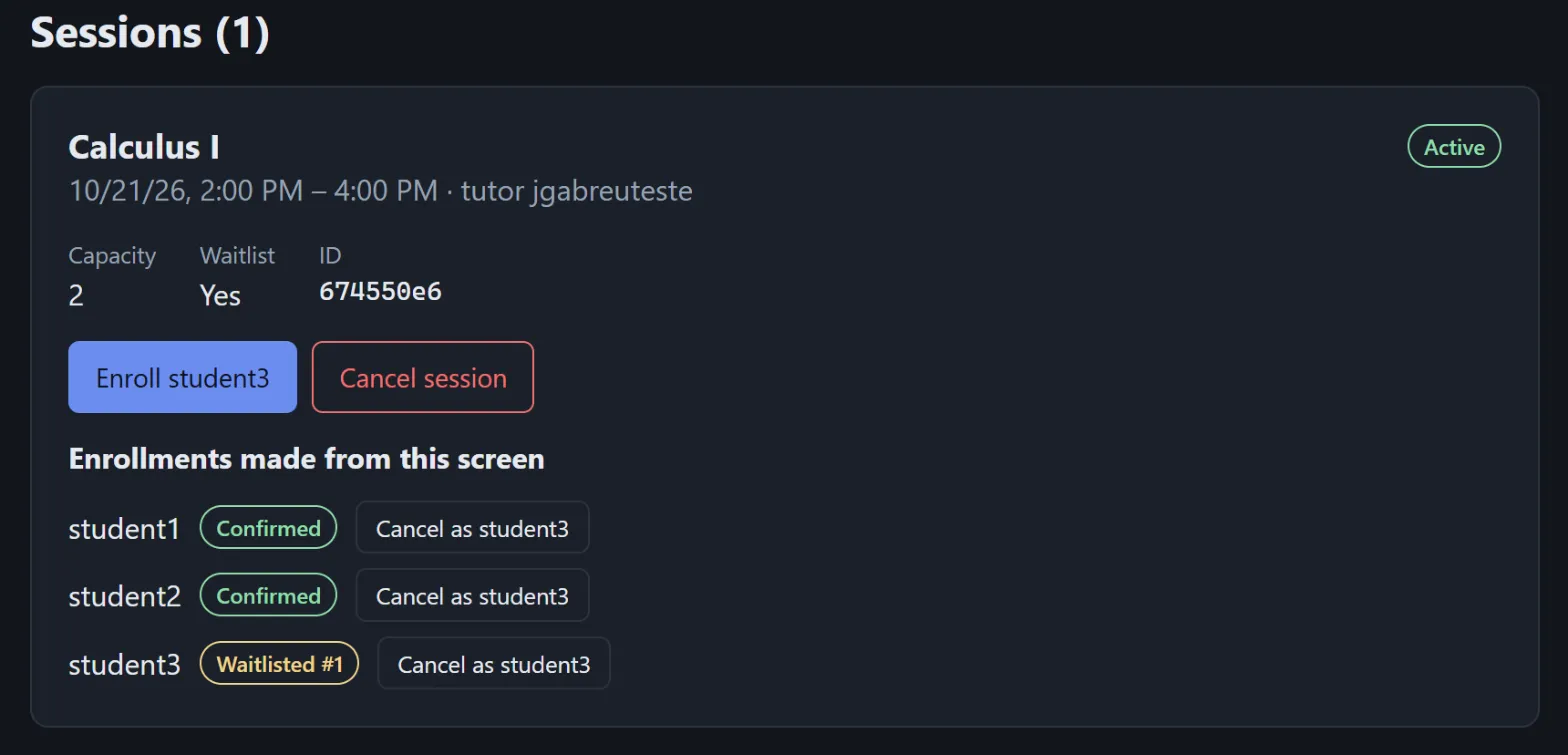
- Capacity and waitlist. Sessions have a fixed number of spots; once full, students join an optional waitlist with a queue position.
- Automatic promotion. When a confirmed student cancels, the first waitlisted student is promoted, the queue is renumbered without gaps and the promoted student is notified.
- Revocation cascade. Revoking a tutor’s bond cancels all of their future sessions.
- Context-based permissions. There is no fixed “tutor” role: what a user can do depends on their relationship to the record. For example, only the admin who approved a bond can cancel its sessions.
- Predictable errors. Domain exceptions map to
400,403,404and409; unexpected errors return a generic500without leaking internals.
Domain model
Every status change goes through a service method that checks the current state first, so an invalid transition returns 409 Conflict instead of corrupting data.
Tutoring bond   requested ──► PENDING ──admin approves──► APPROVED ──admin revokes──► REVOKED
                                 └────admin rejects───► REJECTED       (cancels future sessions)

Enrollment      spot available ──────────────► CONFIRMED ──student cancels──► CANCELLED
                session full, waitlist on ───► WAITLISTED ─promoted─► CONFIRMED
                                               WAITLISTED ─student cancels──► CANCELLED
The schema (users, subjects, tutoring bonds, sessions, enrollments and notifications) was designed and documented before any Java code: UUID keys, native enums, and CHECK constraints such as spots >= 1 and end_time > start_time.
Design decisions
Roles are derived, not stored
A user is a tutor of a subject while they hold an approved bond for it. The same person can tutor one subject and be a student in another, with no role table to keep in sync.
Sessions belong to the bond, not the user
Because every session points to the bond that originated it, the revocation cascade is a single query on bond_id instead of cross-referencing users and subjects.
Nothing is physically deleted
Cancelling, rejecting and revoking are status changes, so the history is preserved.
The database enforces what it can
Besides keys and enums, a partial unique index blocks two live bonds for the same tutor and subject, even if two requests arrive at once.
Business logic lives in the services
Enrollment status has no database default, because confirming or waitlisting depends on counting the spots already taken. The service decides inside a transaction.
Waitlist promotion, in one transaction
cancel(enrollment)
  mark it CANCELLED
  if it was CONFIRMED and the session has a waitlist
    promote the first WAITLISTED student to CONFIRMED
    renumber the remaining queue without gaps
    notify the promoted student
  all of it commits together, or none of it does
Testing and CI
The suite has 61 tests: unit tests for every service (JUnit 5 and Mockito, named should…When…) covering success paths, permission checks and invalid transitions, plus a Spring context test that validates the JPA mappings against the real schema. Each service got its tests right after it was written, not at the end.
GitHub Actions runs the back-end suite against a PostgreSQL service, and lints and builds the front end, on every push and pull request.
Known trade-offs
- Until authentication lands, the acting user’s UUID is sent in the request body; the front end has an “Acting as” switcher to choose who performs each action.
- Admin-only endpoints accept any existing user until user roles arrive.
- There are no
GETendpoints yet.
What’s next (v2.0)
- Authentication, with the acting user taken from the token instead of the request body
- User roles, so admin-only actions are actually restricted
GETendpoints for subjects, bonds, sessions and enrollments- Response DTOs instead of serialized JPA entities
- Cancelling a session or revoking a bond also cancels its enrollments and notifies the students
- Database locking so two students can’t take the last spot at the same time
Run it
The only requirement is Docker:
git clone https://github.com/jg-abreu/tutoring-management-system.git
cd tutoring-management-system
docker compose up --build
Then open http://localhost:3000. Compose starts PostgreSQL with the schema and sample data, the API and the front end. To see the waitlist in action, act as the tutor, create a session with one spot and the waitlist on, enroll three students and cancel the first one.